
A finished display rolling off the production line is not the same as a shipment ready for the retail floor. Several steps sit between those two points, including product pack-out, labeling, palletizing and precise delivery windows.
Key Takeaways
Before planning a first multi-door rollout, consumer packaged goods (CPG) teams should understand these display co-packing and fulfillment basics:
- Core services: Display co-packing and fulfillment can include pack-out, kitting, labeling, palletizing and distribution, bridging the gap between a finished display and a retail-ready shipment.
- Compliance impact: Retailer compliance and distribution planning directly affect whether a shipment gets accepted, received and placed on the floor as scheduled.
- Single-partner advantage: Coordinating display production, pack-out and distribution through one partner can reduce vendor handoffs and simplify a complex, multi-door rollout.
- Pre-production checks: Brands should verify display specifications, labeling requirements and delivery windows with the specific retailer or program before committing to a production timeline.
For CPG brands preparing a multi-door retail rollout, early coordination helps avoid mismatched pallets, rejected labels and missed ship dates.
This guide explores temporary corrugated cardboard retail displays rather than permanent fixtures.
What Is Display Co-Packing and Fulfillment for CPG Brands?
Display co-packing and fulfillment services connect display production to the logistics steps that happen before shipment, from product pack-out and labeling to palletizing and distribution. These services can include assembly, kitting and shrink-wrapping.
Some CPG brands choose the display manufacturer to handle display assembly and pack-out as well. This can reduce the number of vendor handoffs across design, production and fulfillment.

Co-Packing vs. Kitting
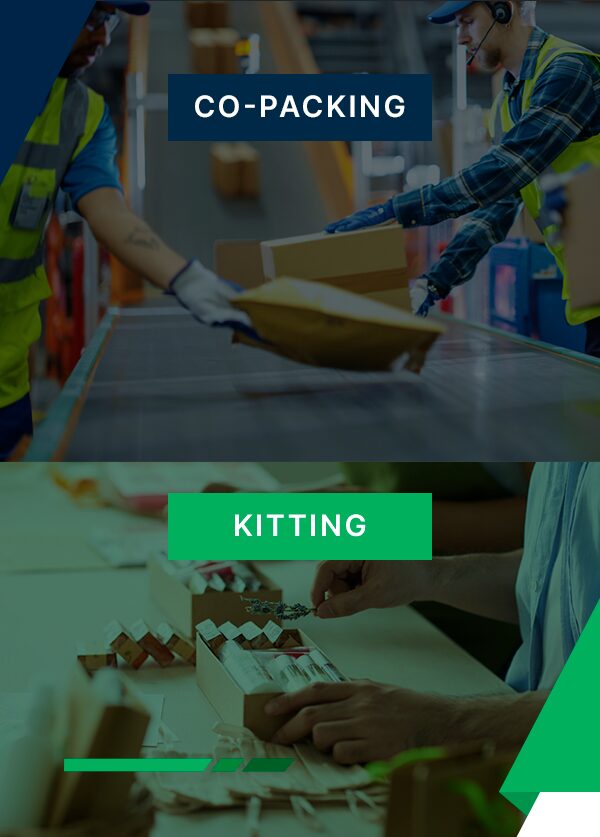
Co-packing and kitting are related but distinct processes, and a single retail display program can involve both. A look at primary and secondary packaging types clarifies where each process fits:
- Co-packing: This process places finished products into or onto a display, box or other retail-ready unit ahead of shipment.
- Kitting: This process groups multiple components, such as a product and a bonus item, into a single packaged unit before it reaches the display.
Multi-packs, PDQs and retail-ready trays often rely on both processes working together. A brand might kit a product with a sample or coupon, then co-pack that kit into a PDQ tray bound for club stores or grocery aisles.
The Association for Contract Packagers and Manufacturers (CPA) maintains a co-packing and contract packaging glossary for brands that want clearer definitions of industry terminology.
When CPG Brands Need Co-Packing and Fulfillment Services
Outsourcing display co-packing and fulfillment is not automatically necessary for every rollout. The right approach depends on internal capabilities, rollout scale, retailer requirements, product complexity and distribution needs.
Preparing Displays for Retail Floor Placement
Some retail programs require products to arrive already assembled into their display rather than shipped separately for in-store assembly. Floor-ready preparation affects several parts of a rollout:
- Product counts: Retailers often specify exact quantities per display. Pack-out needs to match those counts precisely.
- Placement and presentation: Products need consistent orientation and spacing so the display looks intentional on the retail floor.
- Post-delivery work: Floor-ready displays reduce the setup work store staff must complete after the shipment arrives.
Scaling From Small Runs to Multi-Door Rollouts
A process that works smoothly for a small run can become difficult to manage as the number of retail doors increases. Multi-door rollouts introduce new coordination challenges:
- Repeatable processes: Brands need documented pack-out steps that produce consistent results across every batch.
- Quality control: Each display and shipment should meet the same standard, regardless of production volume.
- Labeling and palletization: Shipments should have accurate labeling and a pallet configuration that supports efficient handling at scale.
- Scheduling and coordination: Production, pack-out and transportation all need to align with the retailer’s required delivery dates.
Entering Club Stores
Club-store programs can introduce packaging, product-count, pallet and distribution considerations that differ from standard retail rollouts. Brands should confirm these requirements before production and pack-out begin:
- Packaging format: Club stores often favor multi-packs or bulk configurations over single-unit packaging.
- Product counts and sizing: Case and pallet quantities can differ significantly from those used in standard retail channels.
- Distribution testing: Applicable International Safe Transit Association (ISTA) packaging test procedures can help brands evaluate how a display and its packaging will hold up during club-store distribution, though requirements vary by retailer and program.
How the Retail Display Fulfillment Process Works
The main fulfillment steps include assembly, labeling, pallet preparation and distribution.
Display Assembly and Pack-Out
Display assembly and pack-out bring the display and the product together according to an approved configuration. The steps look different depending on the types of corrugated retail displays involved in a given program:
- SKU quantities: Each display is loaded with the exact product count specified in the approved plan.
- Product orientation: Products are placed and faced consistently so the display presents well once it reaches the floor.
- Display stability: Assembled displays are checked for structural stability before they leave the facility.
- Quality checks: Final inspections confirm that assembly, product placement and packaging all meet the approved standard.
Kitting can enter this stage when multiple components need to arrive as a single retail-ready unit, such as a product bundled with a sample or a promotional insert. Certain PDQ and shipper display formats are built with this kind of kitted pack-out in mind.
Labels, UPCs and Barcode Verification
Product labels, UPCs, GTINs and shipping labels all carry information that retailers rely on to receive and track a shipment. Addressing these details before pack-out helps prevent receiving delays:
- Barcode placement: Barcodes need consistent positioning so scanners can read them without extra handling.
- Readability standards: Print quality and barcode size affect whether a scanner reads the code correctly on the first attempt.
- Verification before shipment: Confirming barcode accuracy before pack-out reduces the chance of mislabeled products reaching a distribution center.
Product identification differs from logistics-unit identification, such as a case or pallet label, which should be checked alongside current GS1 barcode implementation resources.
Some retailers go beyond standard barcoding. For example, Walmart maintains its own RFID tagging and labeling requirements.
Pallet Configuration and Corrugated Display Prep
Pallet configuration affects far more than appearance. It influences stability, handling, warehouse receiving, transportation and how well the display survives the trip:
- Display orientation: Displays get positioned on the pallet to protect their structure during transit.
- Stack height and weight distribution: Even weight distribution and appropriate stack height reduce the risk of shifting or crushing.
- Shrink-wrapping and protective materials: Proper shrink-wrapping and cushioning help keep displays secure without adding unnecessary material.
- Consequences of poor configuration: Incorrect pallet setups can contribute to rejected or delayed shipments and transit damage.
Reviewing pallet labeling and packaging specs ahead of production can help catch configuration issues before they affect a shipment.
Retail Distribution and Shipment
A finished display unit still needs to reach the correct destination in the required configuration and within the scheduled time frame. Assembly alone does not make a shipment rollout-ready, since retail display distribution and shipping still have to align with the retailer’s network:
- Shipment timing: Production and fulfillment schedules need to account for the retailer’s required delivery date.
- Routing information: Accurate routing details help shipments reach the correct distribution center or store location.
- Delivery windows: Retailers often specify appointment times, and missing them can delay receiving.
- Production-to-transportation coordination: Clear communication between the fulfillment team and the carrier helps keep the shipment on schedule.
Retailer Compliance Requirements CPG Brands Must Know
Retailer compliance can determine whether a shipment gets accepted, received or placed on the floor as planned. Noncompliance may contribute to chargebacks, rejected shipments, additional costs or delays, depending on the retailer and program.
General industry practices provide a helpful starting point. Brands should verify current specifications, fees and requirements directly with the retailer or program documentation before locking in a rollout timeline.
Display Dimensions, Footprints and Weight Specs
Display dimensions, footprint limits and weight restrictions affect more than whether a display fits its intended space:
- Design and product capacity: Confirmed dimensions guide how much product a display can hold without exceeding retailer limits.
- Palletization and transportation: Footprint and weight specs influence how displays get palletized and shipped efficiently.
- Store placement: Retailers often set footprint limits to fit specific aisles or floor layouts, and POP displays need to match those constraints.
Brands should confirm current retail-ready display compliance requirements directly with the applicable retailer or program documentation before production begins.
Barcode, UPC and Retail Packaging Labeling Standards
Barcode format, size, placement and readability all factor into whether a shipment clears receiving without issue:
- Point-of-sale identification: Product-level barcodes need to scan accurately at checkout.
- Case-level identification: Case labels carry different information than individual product labels and support receiving at the case level.
- Logistics-unit identification: Pallet or shipping-unit labels help distribution centers track larger shipments through the supply chain.
No single barcode or logistics-label format applies universally across every retailer, so brands should confirm specific requirements while using the current GS1 2D barcode retail guidance for general context.
Routing Guides, Ship Windows and OTIF Requirements
Retailer routing guides often specify shipment preparation steps, required documentation, delivery appointment procedures and other logistics requirements.
On-time, in-full delivery, commonly called OTIF, measures whether a shipment arrives within the agreed delivery window and contains the complete, correct order. Meeting agreed delivery windows supports smoother retail distribution and fewer disruptions to a retailer’s inventory planning.
Specific OTIF percentages and penalties vary by retailer and are not universal across the industry. Brands should reference current retailer documentation. A CPG retail display program checklist can help brands track these requirements alongside routing and delivery expectations.
Vendor Checklist for Display Co-Packing and Fulfillment
Evaluating a potential co-packing and fulfillment partner works best with a clear set of questions in hand, ideally alongside writing a retail display brief that documents the rollout’s scope. The list below can help a brand compare capabilities before committing to a rollout:
- Confirm in-house services: A partner who manages assembly, kitting, labeling, pack-out and distribution directly can reduce the number of vendors involved in a single rollout.
- Document retailer-specific requirements: Ask how specifications, routing guides, labeling rules and delivery requirements get captured, documented and verified before production.
- Request performance proof: Look for measurable service-level details — such as years of industry experience, relevant certifications and a specific on-time delivery percentage — rather than a general reliability claim.
- Verify quality-control steps: Ask about display assembly checks, product counts, orientation, barcode and label verification and final inspection before shipment.
- Double-check lead times: Confirm how design approval, display production, product arrival, pack-out, quality control and transportation each affect the overall schedule.
- Plan for club-store requirements: Determine whether the provider has direct experience with the packaging, palletization and distribution requirements that club programs often involve.
- Clarify escalation procedures: Confirm documentation practices, corrective actions and who takes responsibility for communication.
Common Mistakes to Avoid With Retail Display Rollouts
A first retail rollout often surfaces the same handful of mistakes worth reviewing ahead of production and pack-out:
- Missing retailer display specifications: Incorrect dimensions, footprints or weight requirements can lead to costly revisions or an unsuitable display. Confirm current retail-ready display compliance requirements before production begins.
- Barcode or labeling errors: Incorrect or unreadable identification information leads to receiving or compliance problems. Validate UPCs, GTINs, labels, barcode placement and retailer-specific requirements before pack-out.
- Transit damage: Damaged displays or products affect presentation and often require replacement or rework. Review pallet configuration, protective materials, stacking and applicable distribution testing before shipping.
- Delayed shipments: Missed delivery windows can disrupt an entire rollout schedule. Build realistic production, pack-out, quality control and transportation timelines into the launch plan from the start.
- Incorrect pallet configuration: Poor configuration creates handling, storage, transportation or receiving problems. Verify pallet dimensions, weight, stack height, orientation and retailer requirements before finalizing the load.
- Underestimating club-store complexity: Club-store programs may involve different packaging, testing or distribution considerations than standard retail. Address retailer-specific requirements early.
Display Co-Packing and Fulfillment FAQs
A few additional questions often arise as brands plan their first display co-packing and fulfillment program.
What is the difference between co-packing and contract packaging?
The terms overlap significantly, and usage can vary between providers. Co-packing typically refers to placing products into retail-ready packaging or displays. Contract packaging can describe a broader range of packaging services.
Brands should evaluate the specific services included in a provider’s scope rather than relying solely on terminology.
How far in advance should CPG brands plan display co-packing and fulfillment?
Planning time depends on display complexity, product availability, retailer approvals, order quantity and number of doors. Working backward from the required in-store date and allowing time for approvals, production and shipping, gives a realistic planning window.
Should a CPG brand use the display manufacturer for fulfillment?
Using the display manufacturer for fulfillment can reduce handoffs, since one team manages the entire process. Coordinating separate vendors may suit brands with an established fulfillment infrastructure.
Comparing capabilities, lead times, communication and quality control can help determine the better fit.
Partner With Creative Displays Now for Your Next Retail Rollout
Brands managing a complex, multi-door rollout can benefit from a single partner across production and fulfillment. This approach reduces handoffs and simplifies planning. Creative Displays Now supports CPG brands across key stages of a retail rollout, including display design, production, product pack-out, kitting, labeling and distribution.
We bring more than 60 years of experience and ISO 9001:2015 certification to every project, consistently aiming to maintain an on-time delivery rate of above 99%.
Contact Creative Displays Now to discuss first-time multi-door rollouts, timelines and retail-floor readiness.