

 1-866-244-2214
Launching a retail display program often requires adhering to tight timelines and strict budget considerations while coordinating with multiple internal stakeholders. A structured, phase-by-phase approach can reduce costly mid-production revisions, lower the risk of retailer compliance issues and build repeatable processes for future programs. Brand managers can keep programs more organized by moving systematically through each phase.
1. Define Your Display Program Brief
Start by turning the display program from a general campaign idea into a documented brief your internal team and display partner can use. A vague or incomplete brief can create confusion around budget, timelines, production requirements and approval responsibilities.
Before engaging any vendor or agency, the brief should clarify scope, objectives, constraints, decision ownership, required assets, retailer deadlines, budget expectations and product quantities. This level of detail helps each team understand its responsibilities, keeps early planning focused and reduces avoidable back-and-forth.
Set Program Objectives and Scope
Confirm the campaign goal and in-store deadlines, which product to feature and what retailers to target. The display should accomplish a specific outcome, such as trial generation, impulse purchase or brand visibility reinforcement.
Display format decisions should account for the retailer environment, product weight, placement goals and shopper experience rather than aesthetics alone. Retail display program timelines vary significantly depending on complexity, from straightforward single-retailer launches to multiphase national rollouts. Use the in-store date as the starting point for building the timeline. Aligning display format with program objectives for CPG retail displays early can reduce the risk of costly format changes later.
Align Your Internal Stakeholders
Late-stage stakeholder feedback can contribute to production delays and cost overruns, so identify everyone who may need to sign off during the program before design begins. This group may include marketing leadership, legal and compliance, sales, procurement and operations.
Map each stakeholder’s approvals to the relevant project phases using a simple matrix that defines who is responsible, accountable, consulted and informed. Then, share the approval path early so everyone on your team understands when they need to provide input and which decisions are final. This framework also gives the display partner insight into how long it takes to approve design, prototype, artwork and production on your end.
2. Confirm Retailer Compliance Requirements
Verify each retailer’s current compliance specifications before any creative work begins. Building the display concept around accurate requirements from the start prevents expensive, late-stage conflicts, redesigns and delays. Major retailers publish detailed vendor display guides, which are subject to change based on store format and program type — so relying on past programs is risky.
- Maximum height and footprint: Know the exact size limits for each retailer and store format.
- Loaded weight: Verify structural weight limits and product-load restrictions.
- Placement rules: Determine whether you can use pallet-ready displays.
- Assembly expectations: Clarify whether the display must arrive fully assembled, preassembled or with retailer-approved instructions.
- Barcode and labeling requirements: Ensure scanning, inventory and receiving labels follow retailer standards.
Noncompliant displays can trigger chargebacks, rework, shipment rejection or delays in store placement. A display partner experienced with major retailer specifications can identify risks early, protect your timeline and budget and ensure smooth in‑store execution.
3. Develop Your Display Design Strategy
Once you’ve double-checked compliance requirements, it’s time to choose a display structure and merchandising strategy that fits the product, retailer environment and campaign goal. You can customize corrugated cardboard displays to match specific program requirements, including product size, display footprint, placement zone and branding needs. The structural design process should account for product dimensions and retailer constraints to identify potential engineering issues from the start.
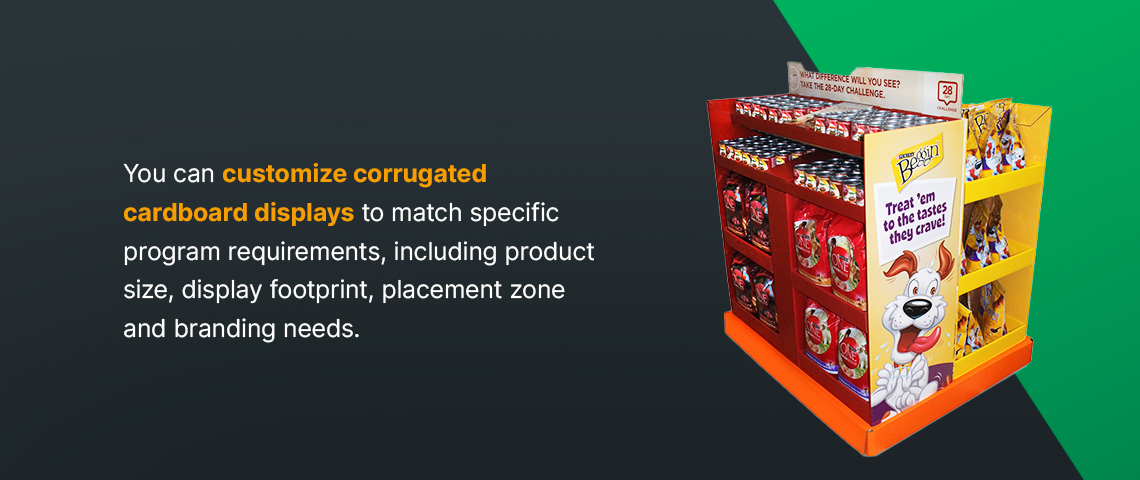
For temporary programs, corrugated cardboard displays made from recycled content can support flexible design options and sustainability goals while giving teams room to adapt the display format to the campaign’s timeline, budget and in-store execution plan.
Use this stage to connect the physical display structure with the shopper experience. Consider how shoppers will approach the display, what product or message they should notice first and how easily the display can be restocked during the program. The design should also account for aisle placement, sight lines, product weight and whether store staff or field teams will handle setup and maintenance.
4. Prototype Review and Signoff
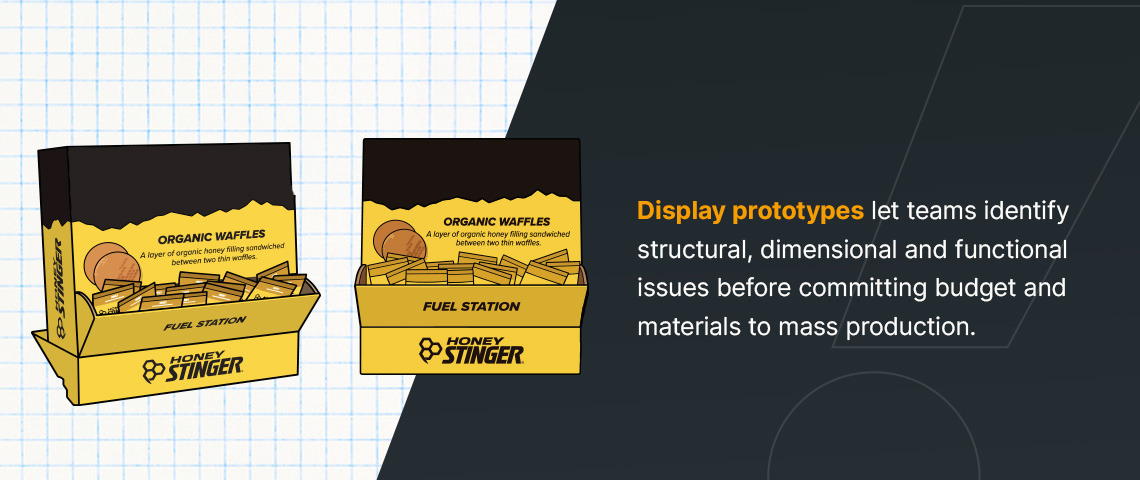
Display prototypes let teams identify structural, dimensional and functional issues before committing budget and materials to mass production.
Evaluate the following factors.
- Product load capacity: Does the display hold the actual product load without sagging or structural compromise?
- Footprint accuracy: The footprint should precisely match the retailer-provided dimensions.
- Assembly feasibility: Is the display assembly straightforward enough for the assigned setup team to execute correctly?
- Product hierarchy: Does the product sit at an appropriate height and visual hierarchy for shopper engagement?
- Brief alignment: The display should match the description in the original brief.
Decide who in the internal stakeholder group needs to review the prototype and what their approval criteria are. Some retailers or programs require compliance with specific display approval processes, which you should determine and factor into your timeline before moving into print or production.
5. Packaging, Branding and Print Approval
With the structural prototype, dimensions and physical format reviewed and approved, branding and print work can move forward. At this stage, the focus shifts to applying brand standards accurately, preparing print-ready artwork and confirming any retailer-required elements before production.
Start by documenting the core brand and print requirements:
- Brand color codes and how they translate to the print method being used
- Logo usage rules, minimum logo sizes and clear space requirements
- Typography hierarchy for primary claims, supporting copy, legal copy and UPC text
- Product claims, promotional language, disclaimers and compliance-reviewed messaging
- Retailer-required barcode placement, price tag areas, label placement or receiving information
Brand consistency across all display panels creates a more cohesive in-store presentation. Corrugated displays can give CPG brands multiple panels for applying brand colors, product messaging and required information consistently. Confirming retail-ready packaging requirements before production can also help reduce the risk of retailer rejections, receiving delays or rework.
Review the dieline or artwork template. Does the file correctly reflect all panels, tabs and structural fold lines? Confirm that color accuracy meets brand standards and ask whether the print process follows recognized color-control standards. Then, review a print proof and ask all required stakeholders to sign off before greenlighting the full production run.
6. Production Planning and Quality Assurance
Production starts once all the relevant stakeholders approve the structure, artwork and retailer requirements. The goal is to keep the schedule transparent, account for quality assurance needs and resolve issues before displays move into distribution or rollout.
Timelines depend on the display’s complexity, quantity, quality assurance needs, pack-out requirements and logistics plan. Delayed approvals can compress the production window, especially if there is limited buffer between the final signoff and the retailer reset date. Build the schedule backward from the required in-store date and confirm production milestones, including:
- Production start confirmation
- Mid-production quality check, if applicable
- Production completion date
- Pack-out start date
- Shipping or distribution handoff date
Quality assurance should happen at multiple points, not just at the end of production. Before displays move into distribution, confirm:
- Materials and specifications match the approved prototype
- Larger production runs include appropriate spot checks
- Retailer requirements for assembling or flat-packing displays
- Packaging, labeling and routing details
A display that arrives damaged, mislabeled or assembled incorrectly can delay placement and reduce the value of the program.
7. Logistics, Distribution and Retail Rollout
After production, the focus shifts to moving displays from the production facility to retail distribution. Careful logistics planning protects the program timeline and reduces the risk of distribution, receiving or store-level setup issues.
Coordinate Pack-Out and Distribution
Pack-out is the process of loading products into the display before shipment, either by the brand, a fulfillment house or the display manufacturer. Decisions include who handles pack-out, how best to ship displays and what pallet configuration and labeling requirements apply under the retailer’s routing guide. Teams should also confirm the lead time between production completion and the required in-store date.
Following the retailer’s routing guide closely helps keep shipments aligned with receiving requirements and reduces the chance of rework for CPG brands. Different display distribution and pack-out models offer varying levels of control over timeline and logistics coordination.
Manage Retail Reset Windows and Store-Level Execution
Retail reset windows are the specific intervals retailers grant for display setup, and timing can vary by retailer, store format and program type. Follow established practices for setting up retail displays to reduce setup errors during the retail rollout phase.
Confirm the following before the retail rollout begins:
- Who is responsible for in-store setup: Store staff, brand field rep or third-party retail merchandising team
- How to communicate assembly instructions: Instruction sheet included in shipment, QR code video or field team training
- Setup verification: Photos, field team reports or retailer confirmation
- Escalation path for rejected displays: Who handles on-site problem resolution if a retailer rejects a display at the store level
8. Post-Launch Performance Tracking
Post-launch measurement lets CPG teams understand what worked, what needs improvement and what should change before the next retail display program. Define the KPI framework before launch so the team knows which sales, compliance and execution data to collect during the program.
Track the metrics that show sales impact, store execution and program efficiency.
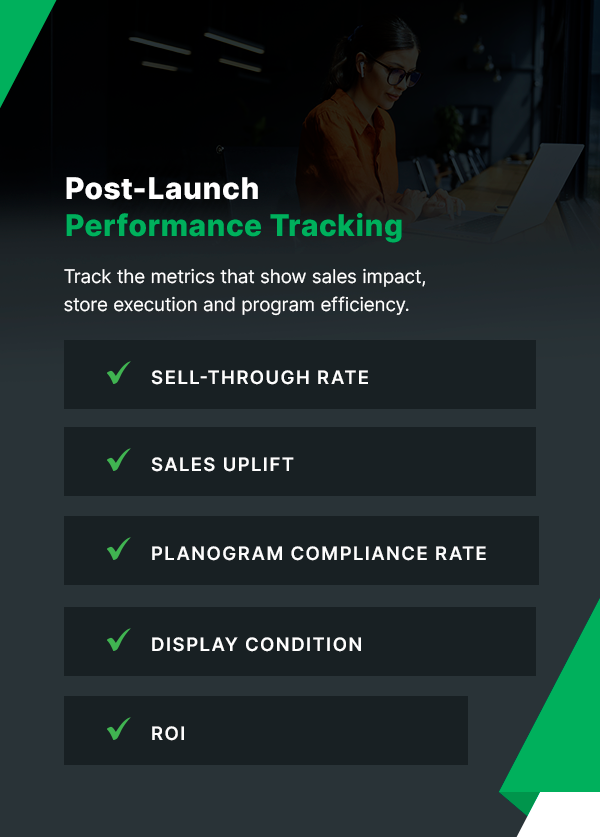
- Sell-through rate: Measure how quickly products move relative to available inventory during the display period.
- Sales uplift: Compare sales velocity before and during the display program.
- Planogram compliance rate: Track whether displays are set up correctly across store locations.
- Display condition: Do your displays stay stocked and in good condition during the program?
- ROI: Factor in display production cost, distribution cost and incremental sales generated.
Assign an owner for each metric before launch so the team knows who’s responsible for collecting data and sharing the results. Establish a preprogram baseline for sales velocity before the display goes up so the team has a clearer comparison point for uplift. No single metric tells the full story, so combine sales velocity, compliance tracking and ROI analysis for a more complete view of performance.
Reframe post-launch data as a planning tool for the next program. Evaluate which display design elements performed well, including size, format and placement zone. Review which retailer locations delivered reliable sell-through, whether the production and distribution timeline was adequate or too short and which compliance or quality assurance issues should be part of future briefs. Over time, simple retrospective documents let your team build institutional knowledge instead of starting from scratch with each display cycle.
Launch Your Next Retail Display Program With Creative Displays Now
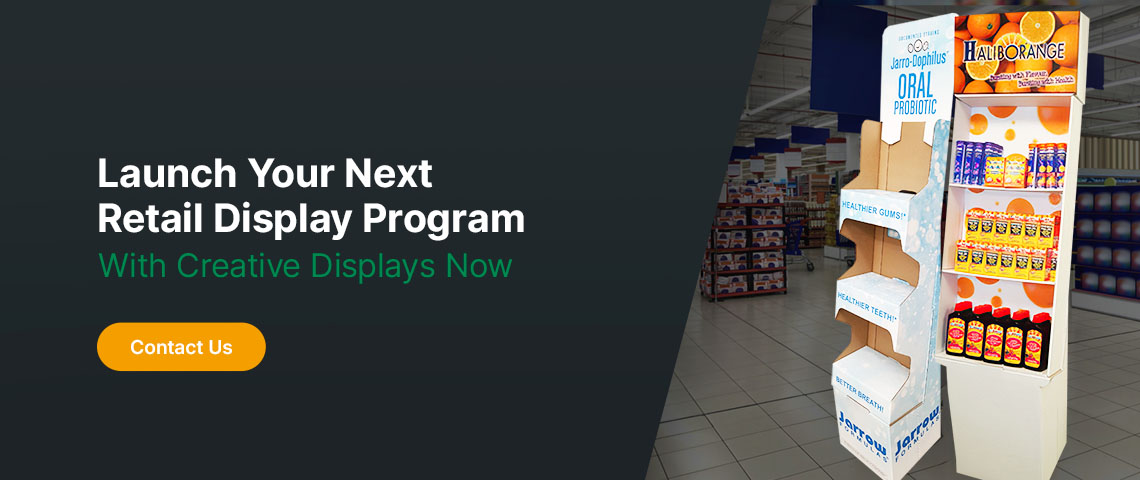
When you are ready to move through this checklist with an experienced execution partner, Creative Displays Now reduces the need to coordinate multiple vendors across phases. With over 60 years in the display and packaging business, our team includes 60-plus structural designers who handle prototyping, printing, manufacturing and distribution under one roof.
The result is a streamlined process backed by over 99% on-time performance and ISO 9001:2015 certification. Every display is fully custom, designed to meet your specific program requirements and retailer compliance specifications. Contact Creative Displays Now today to start planning a corrugated cardboard display program built around your products, timeline and retail requirements.