
Key Takeaways
Here’s a quick look at what to expect once a design moves from prototype to retail-ready production:
- Two approvals start the clock: Structural prototype sign-off and final art approval must be complete before a custom retail display enters production.
- Production follows a set order: Verifying that your final specs align with retailer requirements comes first. This is followed by artwork approval, prepress and printing, manufacturing and fulfillment.
- Lead times are fairly predictable: Corrugated displays typically take five to 15 working days to produce after both structural and art approvals are received, plus transit time. Specifics will depend on the tooling and printing needs.
- Approval timing is a big controllable factor: Early, coordinated sign-offs protect a launch date more than almost any other variable in the process.
You approved the prototype, so why isn’t your display on the retail floor yet? Many first-time buyers assume prototype approval is the finish line. The truth is that a few more checkpoints remain between a signed-off design and a finished custom retail display on the store floor. Questions can quickly surface about what still needs sign-off, how long each stage takes and where delays can occur.
On the path from prototype to production, it’s important to know what to expect after you approve your display design. The process typically runs through several stages, each with its own approvals and lead times.
This guide covers what happens after prototype approval to help streamline the process, from specs and artwork through printing, manufacturing and delivery.
What Happens After You Approve Your Display Prototype?
Once a prototype display earns final sign-off, a few more steps stand between that approval and a retail-ready product. Final specifications and artwork get locked in, then the project moves through prepress and printing, manufacturing and assembly and distribution, with pack-out added when a program calls for it.
Structural, unprinted prototypes are typically offered at no additional charge, while printed prototypes usually carry a separate fee. Prototype approval often covers only the structure, with artwork approved separately, so confirm with your project team which sign-offs are still open before treating the prototype approval process as complete.
Step 1: Confirm Final Specifications and Retailer Requirements
Once your structural prototype is locked in, confirming your final specifications ensures your retail displays align with store guidelines before production begins:
- Dimensions and weight per SKU: Confirm fill weight, center of gravity and shelf-loading limits. This ensures a corrugated cardboard display doesn’t sag or buckle under the weight of real products.
- Retailer footprint and height limits: Respect footprint boundaries and height restrictions for store safety. For example, Kroger’s display guide caps large floor stands at 56 inches tall, but always confirm limits with a buyer before locking in the specs.
- Assembly method: Decide how the display ships and assembles, whether as a pop-up or multipiece build, since simpler setup helps retail staff or fulfillment houses execute it correctly.
- Brand guidelines: Keep logos, messaging and barcodes unobstructed so the finished display still meets merchandising standards.
Step 2: Approve Artwork and Print Files
Artwork review covers a different set of details than your structural sign-off. Buyers must verify color accuracy against brand standards and check that graphics align with the dieline. You will also confirm that logos are high-resolution and that barcodes and compliance text are positioned where they won’t get folded or cut.
Structural approval locks in the physical shape of a custom retail display, while art approval locks in its visual wrap. Discuss your artwork needs with your project team, as manufacturing lead times don’t begin until both the structural prototype and final print files are approved.
Step 3: Prepress and Printing
Once both approvals are confirmed, files move into prepress, where structural specs and print graphics are paired, color-matched and prepped for the press:
- Lithography and litho-lamination: These methods typically suit high-end brands that need photo-quality graphics and premium shelf appeal on corrugated cardboard displays.
- Flexography: Flexo works well for higher-volume runs with simpler artwork. The process offers efficient, direct-to-board printing for standard retail programs.
- Digital printing: Digital is usually the go-to option for shorter runs, test markets or rapid prototypes. This is because digital printing skips the traditional plate-making process and allows for quick setup.
When evaluating a print partner, look for a G7 Master Qualification, which points to rigorous color control across lithographic presses. G7 supports consistent, accurate color, but the final match still depends on artwork, substrate and print method.
Step 4: Manufacturing and Assembly
Centralizing die-cutting, finishing and structural assembly alongside printing supports tighter quality control throughout the manufacturing process for corrugated displays. Before a display is finished, panels are precision-cut, scored and assembled against the approved structural prototype. The display will then be checked for alignment with the final print graphics.
Sustainability is also a priority for many brand teams. The American Forest & Paper Association reports a U.S. recycling rate of between 70% and 75% for cardboard as an industry-reported national range. While corrugated packaging and displays are widely recyclable and frequently incorporate post-consumer recycled content, exact percentages depend on the specific board grade selected. For this reason, it’s important to confirm exact material specs with your project team.
Step 5: Fulfillment and Delivery
Assembly and pack-out details depend on your program scope. Be sure to confirm the logistics plan when requesting your estimate for retail displays:
- Who packs the display: The brand, a dedicated fulfillment house or the display manufacturer can handle pack-out, depending on what the program needs.
- How displays ship: Retail displays can ship flat for on-site assembly or prepacked and ready for the floor, followed by reliable distribution via freight or truck.
- What supports quality assurance: ISO 9001:2015 certification and a strong on-time delivery record are good indicators, though performance metrics reflect a company’s overall history rather than any single project.
How Print Proofs and Art Approval Work
Once structural prototyping wraps up, the project shifts from three-dimensional shape to two-dimensional graphics. Art approval is the final checkpoint bridging design and physical production for a custom retail display. Exact proof steps vary by project, so confirm what your project team will send for review.
What to Review Before You Sign Off
Review these details before signing off on proofs for POP displays or larger-format programs:
- Confirm all panels, tabs and fold lines match the approved structural prototype exactly.
- Specify your palette in Pantone or CMYK values rather than color names, since printed color can vary across substrates and print methods.
- Verify that logos are prominent, properly sized and clear of obstructions.
- Confirm that barcodes and labels meet the retailer’s exact scan requirements.
- Check that regulatory text, disclaimers and required symbols are legible.
- Double-check any compliance badges or markings a specific retailer requires for POP displays.
Why Art Approval Starts the Production Clock
Manufacturing can’t schedule press time or die-cutting runs around unconfirmed print files, even when every other piece of a project is ready to go. A structural prototype might be fully approved and tooling already in place, but display manufacturing still can’t move forward until art sign-off comes through. That single pending approval pauses every stage that follows it, from prepress through fulfillment.
Lead times begin when both approvals are received. This means that a late art sign-off can delay every subsequent stage. For buyers juggling multiple stakeholders, this is often where otherwise on-track projects lose the most time, simply because a final sign-off sat in an inbox longer than planned.
Navigating Production Timelines
Once both approvals are locked in, production usually moves on a fairly predictable schedule. Production timing is separate from the full program timeline from brief to in-store date, which depends on more than manufacturing alone.
Typical Lead Times After Approval
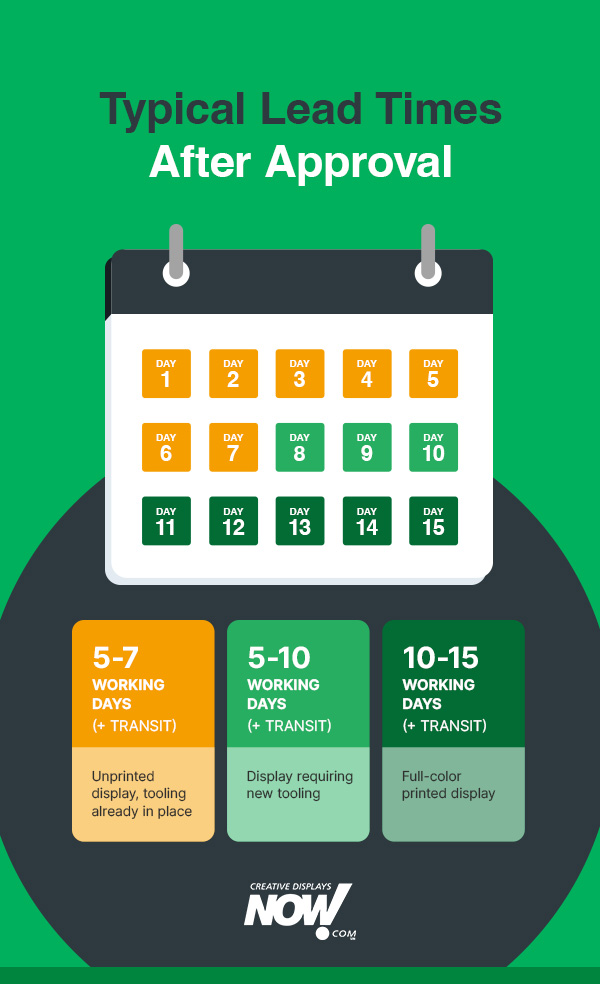

Standard production workflows in a timeline to market typically follow these turnaround windows once approvals are nailed down.
| Production Type | TYPICAL Lead Time After Approval |
|---|---|
| Unprinted display, tooling already in place | 5 to 7 working days (+ transit) |
| Display requiring new tooling | 5 to 10 working days (+ transit) |
| Full-color printed display | 10 to 15 working days (+ transit) |
Because every program has unique requirements, these are typical ranges for custom retail display and corrugated display programs. Specific timing depends on project complexity and print specs, while freight transit time is always additional.
How Quantity Affects Your Path
Order quantity shapes which print method and tooling make sense for a custom retail display program:
- Print method: Digital direct printing typically works well for lower-volume runs, including emerging-brand orders in the 100- to 500-unit range, depending on project needs.
- Tooling: Larger runs justify the time and cost of new structural tooling, while smaller runs often work with tooling already in place.
- Delivery logistics: Bigger orders may ship in stages across multiple pallets or trucks, while smaller runs typically move in a single shipment.
The lead times above are tied to print status and tooling rather than unit count, so ask your project team whether run size changes timing for your specific program.
How to Avoid Common Production Delays
Most production delays are likely to be traced back to approval timing, revision rounds and unclear specifications rather than manufacturing. Coordinating sign-offs across stakeholders and locking in specs early protects a launch date more than many other factors in the process.
Align Approvals Early
A simple responsibility matrix, like a display program checklist, shows who approves the design, prototype, artwork and production for a custom retail display program. Be sure to:
- Determine who on your team holds sign-off authority for each project phase.
- Lock in structural approval before finalizing 2D print graphics.
- Build revision buffers into your schedule instead of rushing final file submission.
- Share your internal approval workflow with your project team early so everyone stays aligned on milestones.
Two revision rounds are a good planning buffer, not a strict rule, so build in more if several stakeholders need to review.
Plan Backward From Your Retail Launch Date
Working backward from a hard retailer deadline often reveals how little flexibility a timeline actually has. Freight transit comes off the calendar first, followed by pack-out and fulfillment, then the manufacturing lead times covered earlier. Prototyping and initial approvals sit at the very start of that sequence, well before a single retail display reaches a press.
A reverse timeline like this typically puts production roughly eight to 10 weeks ahead of an in-store date for standard programs. Those timeline windows assume clean approvals, so every revision or late sign-off shortens the time available for the next steps.
Prepare Delivery and Pack-Out in Advance
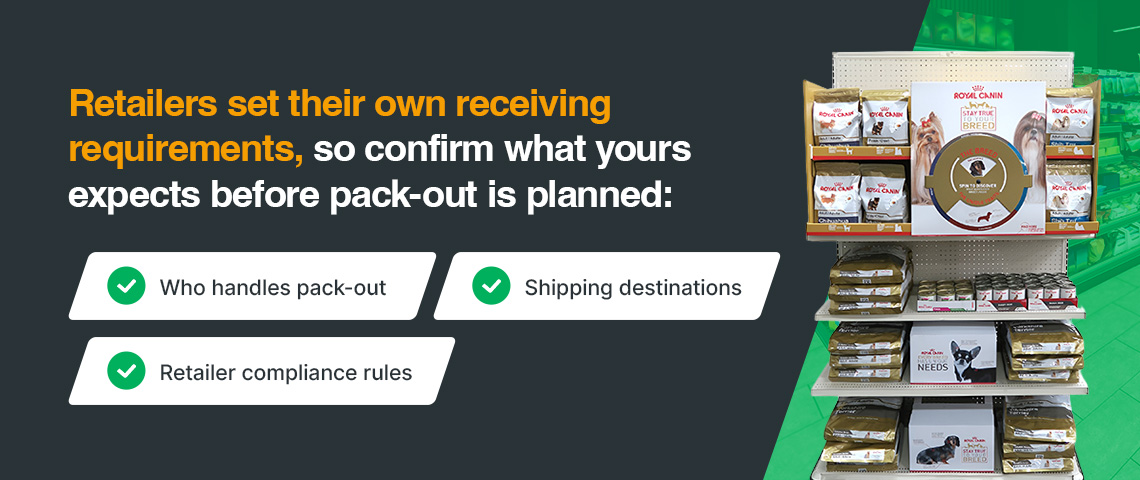
Retailers set their own receiving requirements, so confirm what yours expects before pack-out is planned:
- Who handles pack-out: Decide whether products are loaded into displays in-house, sent to a dedicated fulfillment house or packed directly by your manufacturing partner.
- Shipping destinations: Map out whether POP displays ship to individual retail locations, centralized distribution centers or club warehouses.
- Retailer compliance rules: Review pallet dimensions, labeling requirements and delivery window restrictions to prevent rejected shipments at the dock.
Frequently Asked Questions
You may have some questions once a display design is approved and production is underway.
What is the lead time for custom corrugated displays after approval?
Lead times typically run 5-7, 5-10 or 10-15 working days after approvals. Transit times can also factor into a timeline, depending on the project. Unprinted displays with tooling already in place tend to move faster, while full-color printed runs take longer due to prepress and press scheduling. For exact timing on pack-out or fulfillment, check with your project team.
What is the minimum order quantity for corrugated displays?
There’s no strict minimum, though custom runs generally require a baseline quantity — such as 300 to 350 — to efficiently cover setup and tooling costs. Smaller runs may still be possible using a digital press, which skips traditional plates. Your project team can help match run size to your budget and timeline.
Can a display manufacturer pack out displays before they ship to retailers?
Yes. A display provider can handle assembly and pack-out as part of the program, or a dedicated fulfillment house can take on that role instead. The best option usually depends on program scope, product type and shipping destination. Confirm pack-out responsibilities early so they don’t become a bottleneck later in production.
Can I order custom corrugated displays with a fast turnaround?
Turnaround depends on approvals, tooling and print method more than any single request for speed. Early sign-offs and efficient in-house workflows help keep a project moving as quickly as the process allows. Expedited dates depend on real-world variables like approval timing, print complexity, tooling and retailer specs.
Get Started With Creative Displays Now
Creative Displays Now handles structural design, printing, display manufacturing and distribution for temporary corrugated cardboard displays under one roof. Our 60+ structural designers support efficient, responsive project movement. We keep communication simple and your production timelines predictable. Backed by ISO 9001:2015-certified processes and more than 60 years in the display and packaging business, we help first-time and early-stage consumer packaged goods (CPG) brands move with confidence.
The result is a custom retail display that reaches stores with fewer surprises along the way. Our production lead times begin once both structural and art approvals are in hand, not when you first reach out, so locking in specs and artwork early helps manufacturing start sooner.
Request a custom display estimate today to share your display type, quantity and graphics needs.