

 1-866-244-2214
For consumer packaged goods (CPG) brands, a custom corrugated display acts as a silent salesperson, lifting your products above the shelf clutter and guiding shoppers toward a purchase. But when it’s time to budget for one, brand managers and procurement leads often hit the same wall. Pricing feels like a black box.
Custom corrugated display pricing is driven by a clear set of cost factors, and once you understand them, you can build an accurate budget estimate before requesting a quote.
What Are Custom Corrugated Displays?
A custom corrugated display is a merchandising structure made primarily from corrugated cardboard, designed to showcase your products at the point of purchase. These point-of-purchase displays, or POP displays, are placed in retail stores to launch new items, support promotions and strengthen brand visibility to influence buying decisions.
A popular and cost-effective option for CPG brands is the temporary corrugated cardboard display, built to run for months during a campaign rather than years, as with a permanent fixture. Temporary corrugated displays are flexible to swap out when campaigns change, more affordable than permanent options and highly printable for strong branding.
Corrugated displays span a wide range of formats:
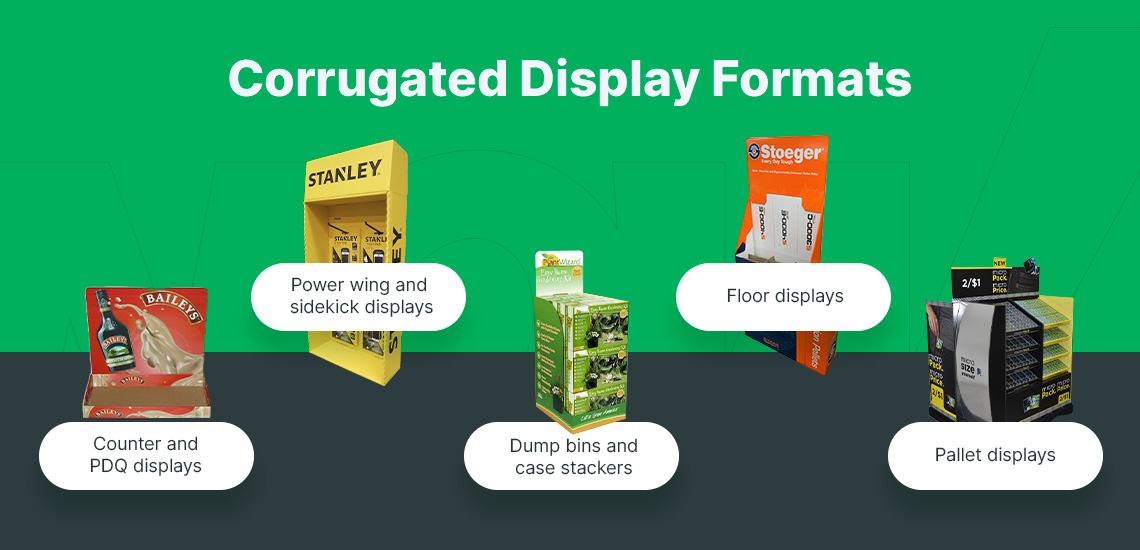
- Counter and PDQ displays sit at the register or on a shelf to capture impulse buys at checkout.
- Power wing and sidekick displays hang from an existing shelf to add aisle visibility and cross-merchandise complementary products.
- Dump bins and case stackers hold bulk product for promotions and clearance.
- Floor displays and freestanding stands anchor product launches and hero SKUs in high-traffic zones.
- Pallet displays ship preload for warehouse clubs and big-box bulk sales.
Choosing the right format starts with the shopper behavior you want to influence. For a broader look at how the formats stack up, this overview of the most effective types of retail displays is a helpful companion to this pricing guide.
The Key Cost Drivers
Custom corrugated display pricing is determined by several variables that combine to set your per-unit cost. Understanding each one helps you budget accurately and brief a manufacturer clearly, which consistently leads to better pricing.
1. Order Volume
Order volume tends to have the biggest influence on POP display pricing. Manufacturing carries fixed setup costs, such as cutting dies, printing plates and machine calibration, that get spread across the total run, so larger orders generally bring the per-unit cost down. The curve is steepest at the low end, where setup weighs heavily on a small number of units, and tends to flatten as quantities climb into the thousands.
That said, bigger isn’t always better. Plan your volume based on your actual distribution footprint and upcoming promotions, and avoid over-ordering displays you can’t deploy before the artwork or program expires. A useful rule of thumb is to map your quantity to confirmed retailer commitments first, then add a modest buffer for replacements rather than speculative placements.
2. Structural Design
A simple counter unit costs far less to engineer and produce than a multitiered floor display with custom cutouts, angles or interlocking components. Intricate builds take longer to design, require more elaborate dies and add assembly steps. Heavier products such as beverages, canned goods or nutritional products also require reinforced shelving and higher-grade board. Sizing the display to your product’s actual weight and footprint, and no further, is one of the easiest ways to avoid overspending.
This is where engineering expertise pays for itself. A strong structural design process balances shelf impact against material use, so the display holds up through the campaign without carrying costs you don’t need. Sharing accurate product weights and dimensions early lets the design team specify exactly the right amount of board.
3. Materials and Board Grade
Corrugated is economical, but not all corrugated is equal. The flute grade — E, B, C or double-wall — affects strength and price. Lighter products may only need E-flute, while heavier or longer-running displays call for C-flute or double-wall. Linerboard quality also matters, and brighter, smoother liners yield crisper graphics at a premium. Over-specifying adds cost with no benefit, but under-specifying produces a display that underperforms in-store.
Corrugated also carries a sustainability advantage that increasingly matters to retailers and shoppers alike. Because the material is widely recyclable and made largely from post-consumer content, choosing corrugated can support your environmental goals while keeping costs in check.
4. Print Method
Graphics drive a display’s impact, and the print method is a major cost factor. The three most common options each suit a different kind of job:
- Flexography: Economical for simpler graphics, solid colors and larger runs.
- Litho-lamination: A lithographic sheet laminated to the board for high-end, photographic-quality graphics.
- Digital printing: Often the most cost-effective choice for shorter runs or multiple design variations.
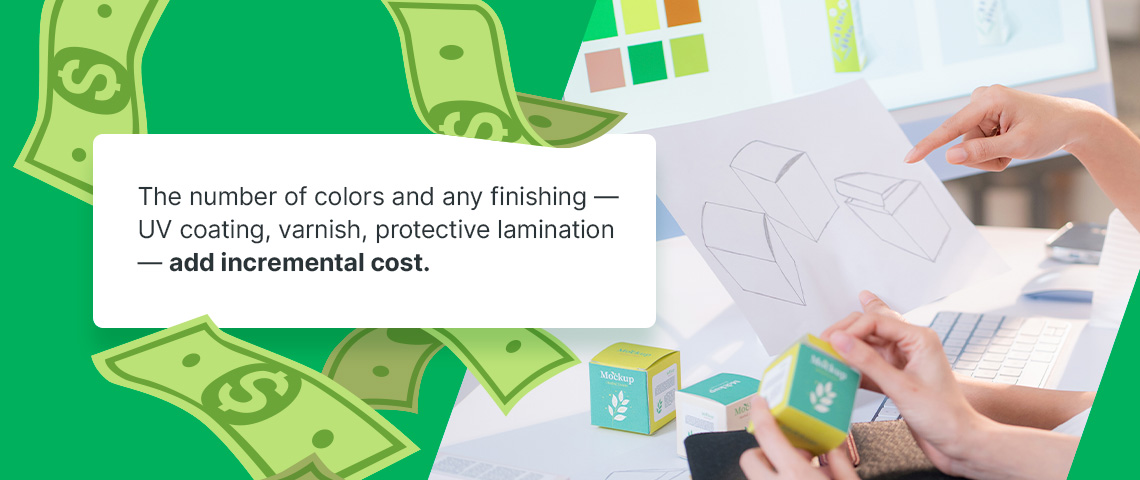
The number of colors and any finishing — UV coating, varnish, protective lamination — add incremental cost. Align print quality with the campaign’s length and the product’s positioning, staying lean for a short promo and richer for a premium, longer-running display.
5. Prototyping
Many teams overlook prototyping when budgeting, yet vendors approach this area differently. Many manufacturers provide structural prototypes at no additional charge, so you can verify size, strength and structure before committing to a full run. Print samples from previous jobs are often available for free as well.
A printed prototype using your artwork typically carries a fee, since it’s a one-off production. Validating fit and structure at the sample stage is far cheaper than discovering an issue after thousands of units are made, which is why the prototyping step belongs in your budget conversation from the start.
6. Assembly, Pack-Out and Fulfillment
How displays arrive affects cost. Most corrugated displays ship flat to keep freight down, and your team or distribution center assembles them on-site. You, a fulfillment house or our pack-out services can load the products. Any added labor — kitting, pre-assembly and pack-out — increases cost but can save time downstream.
If speed to shelf matters for your launch window, factor in assembly and distribution support when you compare quotes. A slightly higher line item there can offset hidden labor costs on your end.
7. Shipping and Logistics
Transporting finished displays to retailers is a variable expense driven by distance, total volume and weight, shipping speed and protective packaging. Designing displays to flat-pack and nest efficiently on a pallet can reduce freight. This is another reason why structural design and logistics planning should happen together rather than in sequence.
Typical Price Ranges by Display Type
Exact pricing varies from one program to the next, since cost is shaped by quantity, structure, board grade and print method working together. Your actual POP display cost will track your specific requirements. Still, it helps to have a general sense of how the formats compare before you request a quote.
As a broad guide, smaller formats like counter and PDQ displays sit at the most accessible end of the range, since they use less material and ship retail-ready. Power wings, sidekicks and dump bins land a step up. Larger, freestanding formats such as case stackers and floor displays call for more board and engineering. Pallet displays, built to carry bulk product for club and big-box channels, typically represent the most significant per-unit investment.
The clearest illustration of how pricing works comes from quantity. The tables below show how the per-unit cost decreases as order volume rises:
Counter Displays
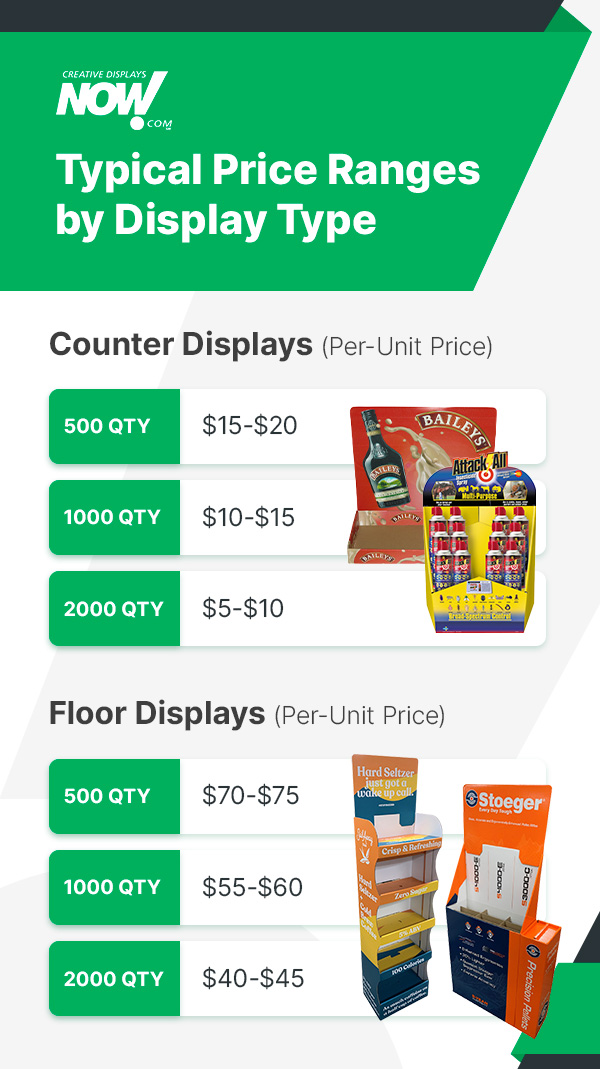
| Order Quantity | Per-Unit Price |
| 500 units | $15-$20 |
| 1,000 units | $10-$15 |
| 2,000 units | $5-$10 |
Floor Displays
| Order Quantity | Per-Unit Price |
| 500 units | $70-$75 |
| 1,000 units | $55-$60 |
| 2,000 units | $40-$45 |
Because even modest changes to design, board grade or quantity can shift these numbers, the best approach is to treat any range as a starting point and refine it against your specific requirements.
Two formats that brand teams often confuse during budgeting are sidekicks and endcaps. If your plan involves either, it’s important to understand the difference between a sidekick display and an endcap display and know where each earns its keep. Additionally, PDQ displays ship retail-ready and drop straight onto a shelf, so they can trim in-store labor costs that don’t show up on the per-unit line.
Why Custom Corrugated Displays Are Worth the Investment
It’s tempting to view a display purely as a line-item expense, but the better lens is return on investment. A well-designed display earns secondary placement outside a product’s normal aisle, interrupts a shopper’s path and tells your brand story at the exact moment of decision. For new launches and seasonal pushes, that extra visibility often boosts sales enough to outweigh the display’s cost.
The cost savings increase when the display does double duty as both merchandiser and shipper. A retail-ready format reduces the handling a store has to do, which makes buyers more willing to grant placement in the first place.
Design quality matters here, too. A display that’s poorly engineered, off-brand or visually flat won’t earn the sales it needs to justify its cost, regardless of how low the unit price looks. Treating display spend as a performance investment, grounded in solid visual merchandising principles, tends to yield far better results than chasing the cheapest possible quote.
How to Optimize Your Display Budget
Controlling cost doesn’t mean sacrificing impact:
- Simplify the structure by removing unnecessary elements, as a clean design often performs as well at a lower cost.
- Right-size your volume to capture the per-unit savings of a larger run while staying realistic about what you can deploy.
- Match materials to the campaign length and keep it lean for short promos, and invest more for displays that need to last.
- Design for efficient shipping so that it displays flat-pack and nests cleanly on a pallet.
- Use free structural prototyping early to protect your larger production investment.
- Brief your manufacturer clearly by sharing product dimensions and weight, number of facings, target retailers, budget and timeline up front.
Common Budgeting Mistakes to Avoid
Even experienced teams run into the same avoidable cost traps. Watching for these budgeting errors keeps your estimate honest and your final quote closer to plan:
- Budgeting from a single number: Treating the cost of a display as one figure ignores how volume, structure and print interact. Build your estimate from the drivers, not from a gut number.
- Overengineering the structure: When the product is light and the campaign is short, specifying double-wall board or a multitier build adds costs that a simpler design would have avoided.
- Forgetting the soft costs: Assembly, pack-out and freight can add up quietly. Account for them early so they don’t surprise you after the unit price is locked.
- Skipping the prototype: Approving a full run without confirming fit and strength increases the risk of a costly reprint or rebuild. A free structural sample acts as affordable insurance.
- Ordering on speculation: Producing thousands of units before retailer commitments are firm leaves you holding displays that may never reach a shelf before the program ends.
- Briefing too late or too thin: The less detail a manufacturer has, the more conservative and expensive their quote tends to be.
Frequently Asked Questions About Corrugated Display Costs
Below are some common questions customers have about corrugated displays.
What Is the Average Cost of a POP Display?
There’s no single average, because POP displays range from a few dollars for a simple counter unit to $70 or more per unit for a loaded pallet display. Your POP display cost depends mainly on quantity, structural design, board grade and print method. The ranges in this guide give you realistic planning benchmarks by display type.
Why Does Ordering More Units Lower the Price per Display?
Display manufacturing carries fixed setup costs that don’t change much, whether you order 50 units or 5,000. Spreading those costs across a larger run lowers the per-unit price, which is why volume is the most powerful lever in corrugated display pricing.
Do I Have to Pay for a Prototype?
Not for a structural prototype. Creative Displays Now provides unprinted structural prototypes at no additional charge so you can confirm size and strength before production. A printed prototype using your own artwork is a one-off production and typically carries a fee, while print samples from previous jobs are available free.
How Long Do Temporary Corrugated Displays Last?
Temporary corrugated displays are engineered to perform for the length of a typical promotion — generally weeks to a few months — rather than years. That focused lifespan is part of what makes them cost-effective for launches and seasonal campaigns.
Are Corrugated Displays Environmentally Friendly?
Yes. Corrugated cardboard is widely recyclable and made largely from post-consumer content, making it one of the more sustainable display materials available for retail merchandising.
How Do I Get an Accurate Quote Instead of a Range?
Share your product’s dimensions and weight, your target quantity, the retailers you’re placing in, your timeline and any artwork or brand guidelines. The more complete your brief, the more precise and often more competitive your quote will be.
Get a Quote From Creative Displays Now
Creative Displays Now brings everything from structural design to distribution under one roof, prioritizing both speed and quality. Our team has:
- Over 60 years in the display and packaging business.
- More than 60 in-house structural designers.
- An ISO 9001:2015 certification.
- An on-time delivery record of over 99%.
- Deep knowledge of the display requirements of major retailers.
Our primary material, corrugated cardboard, means your displays can support your sustainability goals too. Request a custom estimate and turn your concept into a retail-ready display.