

 1-866-244-2214

Key Takeaways
Weight-informed decisions protect both the product and the shopper handling it at retail:
- Heavy and bulky products call for retail displays engineered around product weight, footprint and shopper access as much as visual appeal.
- Get the display format, board construction and peg hook placement right from the start to keep a program merchandising, restocking and holding up safely on the sales floor.
- A point-of-purchase display built for a home improvement retailer or warehouse club has to satisfy that retailer’s own handling, pallet and footprint rules.
- Clear aisles and accessible product placement protect shoppers while keeping displays fully stocked and easy to restock.
Hardware and home goods involve special considerations that lightweight consumer products don’t. A drill kit, a hose reel or a set of hand tools needs a structure that can hold, present and move that weight through a retail environment reliably. Shoppers still stop for displays first. In fact, 77% say eye-catching displays are at least somewhat important to their shopping experience, and floor stands and endcaps account for 86% of the displays shoppers recall from a given trip.
In retail merchandising, product weight is a primary consideration and the starting point for display planning. A well-engineered retail display, whether it’s a temporary corrugated program or a longer-running fixture, carries its load safely and keeps aisles clear, protecting both sales and shopper trust.
This successful engineering depends on five decisions — starting with the right display format, followed by board strength, safe placement, retailer-specific requirements and warehouse club specifications. Each one shapes whether a point-of-purchase display holds up once it reaches the sales floor.
1. Start With the Right Display Format
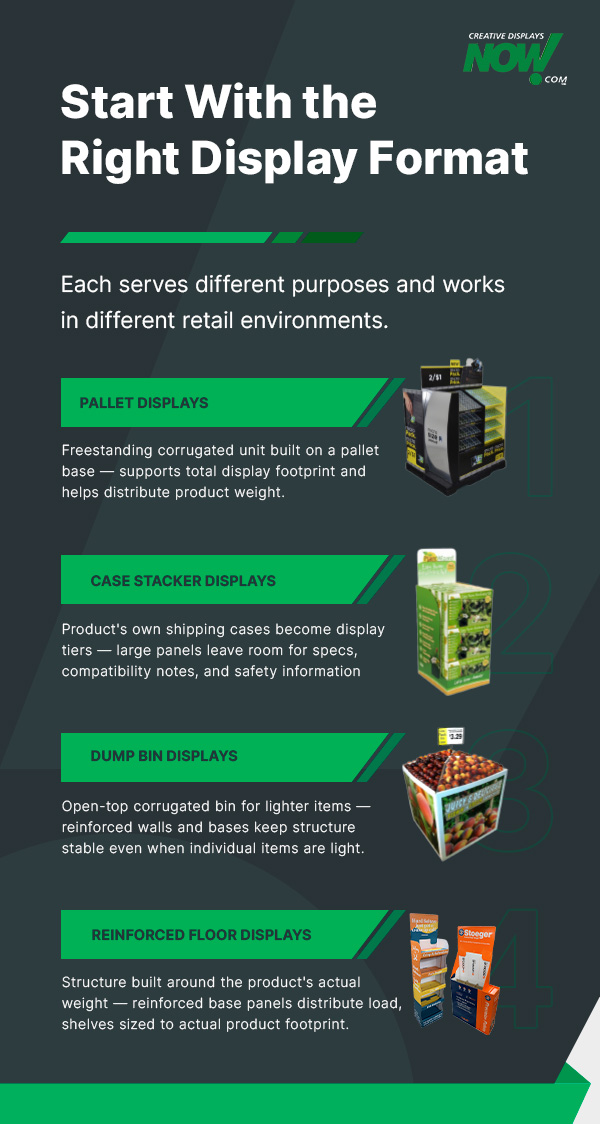
The right product display stand for heavy hardware or home goods starts with a format built for your item’s actual load. Weight, dimensions, unit count, shopper access and stocking needs narrow the options first. Pallet displays, case stackers, dump bins and reinforced floor displays cover most heavy and bulky hardware and home goods programs.
Pallet Displays
A pallet display is a freestanding corrugated unit built on a pallet base. That base supports the total display footprint and helps distribute product weight across the structure. It also doubles as a shipping platform, so the entire program can move through distribution and onto the retail floor as one unit with minimal additional handling.
Pallet displays work well for heavy, high-volume, multi-SKU programs. Multiple shoppable sides help customers reach bulky products without creating traffic jams in busy aisles. Tool sets, hose reels, extension-cord spools, heavy seasonal items and bulk hardware assortments are common fits.
This format appears most often in pallet displays for heavy products at warehouse clubs and large-format home improvement programs, where bulk quantities and mixed product lines are standard.
Case Stacker Displays
A case stacker turns the product’s own shipping cases into display tiers. Each case doubles as packaging and merchandising. Large panels leave room for specifications, compatibility notes, dimensions and safety information, while a header handles brand or campaign messaging without adding a separate structural piece.
Packaged power tools, air filters, storage organizers, lawn equipment accessories and seasonal hardware work well in this format since they stay in their original packaging. This approach can pay off quickly, too, as power aisle stack-outs tested with trash cans have produced a 150% sales lift. When the case itself can carry the message, case stackers for bulky products make sense, since building a separate structure would duplicate work the packaging already does.
Dump Bin Displays
Shoppers reach directly into an open-top corrugated dump bin to grab individually lighter items like drill bits, packaged fasteners, batteries and small hand tools. This format works especially well for promotional products, high-volume assortments and impulse-friendly accessories near checkout or aisle ends.
A reinforced floor display or pallet display suits a single heavy product better, while a dump bin excels at these lighter, multi-unit assortments. Total product weight across the bin can still add up quickly, so reinforced walls and bases help keep the structure stable even when individual items are light. Because dump bins see frequent turnover, they also benefit from a base built to withstand repeated restocking without weakening over time.
Reinforced Floor Displays
A reinforced floor display for heavy hardware differs from a standard floor display because its designers build the structure around the product’s actual weight rather than a generic corrugated layout meant for lighter goods. A single heavy product or a smaller assortment often fits better here than on a pallet display, which generally works best for bulk or pallet-based programs.
Reinforced construction typically includes vertical flute orientation on load-bearing shelves, reinforced base panels that distribute product weight and interior support where needed. Shelves and trays are sized around the actual product footprint. A structural prototype can verify fit, stability and product support before a program moves into full production.
2. Match Your Board Grade to Your Product’s Weight
Corrugated cardboard is not one universal material. Board grade, wall construction, flute profile and structural layout all affect how a display performs once it carries a heavy product’s full load.
Treating every program the same way can lead to a display that looks right but underperforms in the field. Matching board grade to product weight from the start helps avoid that gap.
Board Grade and ECT Ratings
Edge crush test (ECT) measures how well corrugated board resists edgewise compression. It has replaced Mullen burst testing as the leading corrugated benchmark because it more directly evaluates compression-related performance than puncture resistance. This makes it a more useful reference point for how a display holds up under weight.
These common Rule 41 gross-weight reference points are a useful starting point for board selection:
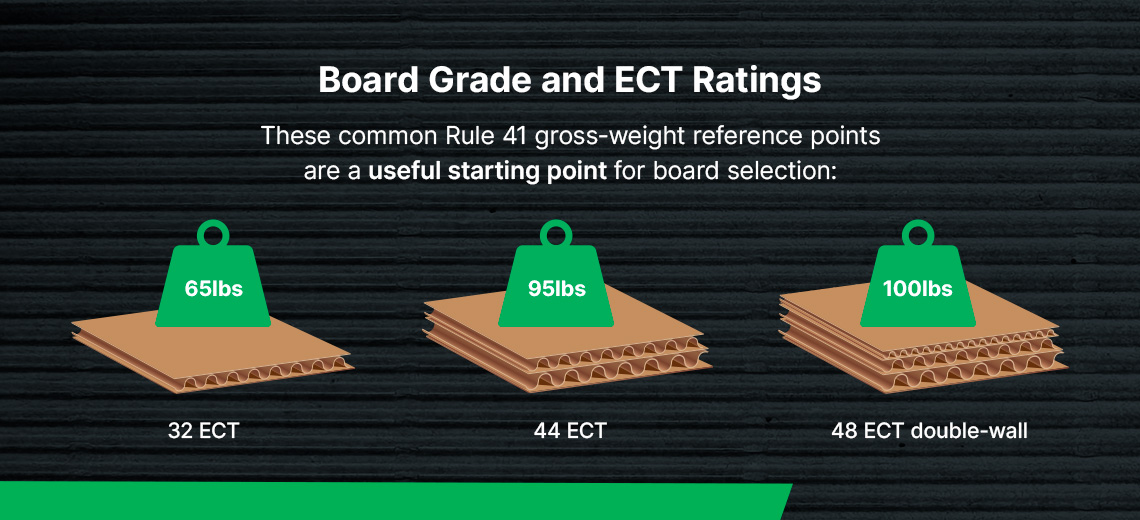
- 32 ECT up to 65 pounds
- 44 ECT up to approximately 95 pounds
- 48 ECT double-wall up to approximately 100 pounds
Many retail displays for lightweight products use standard corrugated builds suited to lighter loads. A hardware or home goods program with substantial product weight often calls for a different approach. The right board grade ultimately depends on the actual product load, product distribution, shelf geometry, transit conditions and retailer handling needs. All of this information is worth confirming before production begins.
Peg Hook Integration
Designers need to build peg hooks into the corrugated display structure during the design phase rather than add them as a late modification once the layout is already final. Hook apertures, hanging slots and support panels function as structural elements within the display, not add-on hardware bolted on afterward.
Peg hooks work well for packaged saw blades, drill bits, fasteners, batteries and blister-packed hand tools. The area around each hook must account for the combined weight of the hanging products. Heavier hanging accessories sometimes need stronger material or backing behind the hook zone.
A structural prototype or detailed spec sheet helps clearly communicate product weight and placement requirements, reducing design back-and-forth. Finalizing peg hook details before approving die lines and tooling helps keep costs predictable and ensures launches stay on schedule.
3. Put Heavy Products at the Right Height
In retail merchandising, heavy-product placement should prioritize shopper safety alongside visual appeal. Where a product sits on a display affects how easily and safely a shopper can complete a purchase without help.
Placement Height and Shopper Access
Products are easier to lift and carry when they sit above the knees, below the shoulders and close to the body. This ergonomic power zone is especially relevant to heavy hardware and home goods display design, since positioning the heaviest products within this zone speeds up restocking and reduces strain on store teams.

Pallet bases can raise products above the ground, while floor displays and case stackers should place heavier products at more accessible levels whenever possible. These fixtures should be at least 3 feet tall to reduce the risk of tripping and to place products closer to the accessible zone. That physical access still matters to shoppers, as 47% say the ability to see and touch products in person is the main reason they shop in-store.
Aisle Clearance and Safety Signage
Measure aisle clearance from the outermost display component, including product overhangs, wide bases and protruding headers that extend beyond the display’s core footprint. Accessible routes require a 36-inch minimum continuous clear width, while aisle-end displays may need a 60-inch turning space requirement so shoppers using mobility devices can turn and move through comfortably.
Visible signage on weight, handling and stability helps shoppers know exactly what to expect at the display itself. Simple language works best, such as “Heavy items: lift with care” or “Ask for assistance.”
4. Know Your Home Improvement Retailer’s Requirements
Retailers set their own vendor, labeling, pallet, shipment and receiving rules. Those rules rarely match from one home improvement chain to the next. Many retail pallet programs default to a standard footprint but confirm the specific retailer, product category and program requirements before anything moves into production.
Working with a display manufacturing partner that addresses this consideration during structural planning keeps programs on budget and on schedule. Whether it’s hardware retail display requirements or supplier labeling and shipment regulations, addressing them early is far easier than fixing them after production starts.
5. Design Differently for Warehouse Clubs
Warehouse clubs bring pallet-based display programs, mechanical handling, high product volume and retail-ready presentation into the same equation as design and branding.
A display built for a traditional home improvement environment requires tailored specifications to succeed under a warehouse club’s rules. Confirming these specifications early also reduces the chance of a pallet program being turned away at receiving, which can delay an entire launch window.
Costco Requirements
Costco pallet programs have to account for footprint, load weight, height, retail presentation and inbound stacking conditions before a product ever leaves the facility.
Footprint and load limits include:
- Costco requires a 48-by-40-inch maximum footprint, keeping product flush with the pallet edges.
- The underhang pallet footprint must be at least 44 by 37 inches.
- Pallet loads should stay within 2,500 pounds and 58 inches in height, including the pallet itself.
Double-stack strength requirements include:
- Pallet loads under 750 pounds support 1,500 pounds on the bottom product layer during stacking.
- Loads weighing more than 750 pounds support 2,500 pounds on the bottom product layer.
Sam’s Club Requirements
Confirm pallet and case-weight rules before approving packaging and display construction for a Sam’s Club program, saving time and cost during production.
Sam’s Club requires a 48-by-40-inch pallet footprint, 9-block pallets and product kept flush within the pallet edges. Case weight should stay at or under 50 pounds, and cases above that threshold require a Team Lift label and buyer exception approval. Pallets should be shoppable from at least two adjacent sides, using solid, fully built-out pallet construction throughout.
Frequently Asked Questions
Structural capacity and retailer compliance are practical concerns when planning a display program for heavy hardware or home goods. Some common questions include:
Can a corrugated cardboard display hold heavy hardware products?
Yes, corrugated cardboard displays can hold heavy hardware when board grade, wall construction, product distribution and structural support all match the actual product load. Evaluating a display as a complete structure offers the clearest picture of its performance, since the interaction between components matters as much as any single spec. Structural review before production helps confirm product fit, stability and long-term support.
What ECT rating do I need for heavy products?
Heavy products typically require an ECT rating of 44-48 or higher. However, the right ECT rating depends on product weight, display geometry, wall construction, transit conditions and retailer requirements. ECT values offer a useful reference point for corrugated board, but pairing them with product load and shelf design shows what a finished display can actually carry. Heavier programs may need stronger material, added structural support or a different display format entirely.
How do I ensure my display meets retailer compliance requirements?
Building compliance into the process from the start means reviewing pallet dimensions, labeling, shipment expectations, product load, shopper access and handling needs before final design approval, not after. Home improvement retailers and warehouse clubs follow their own distinct standards, so a display program should account for the specific requirements of its retail destination.
Get Started on Your Custom Hardware Display
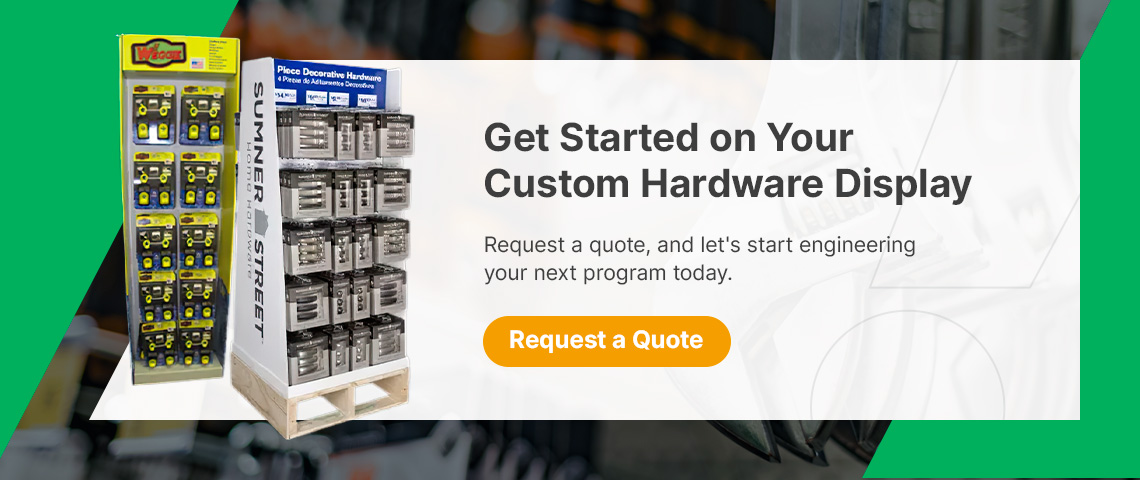
Heavy hardware and home goods deserve a display with structural engineering that supports real product weight and meets retailer requirements with striking, on-brand graphics. Creative Displays Now brings over 60 in-house structural designers, free structural prototypes, a 99.73% on-time delivery record and deep retailer-specification knowledge to every program.
From design through distribution, we build custom corrugated cardboard displays and custom hardware retail displays under one roof. Request a quote, and let’s start engineering your next program today.