

 1-866-244-2214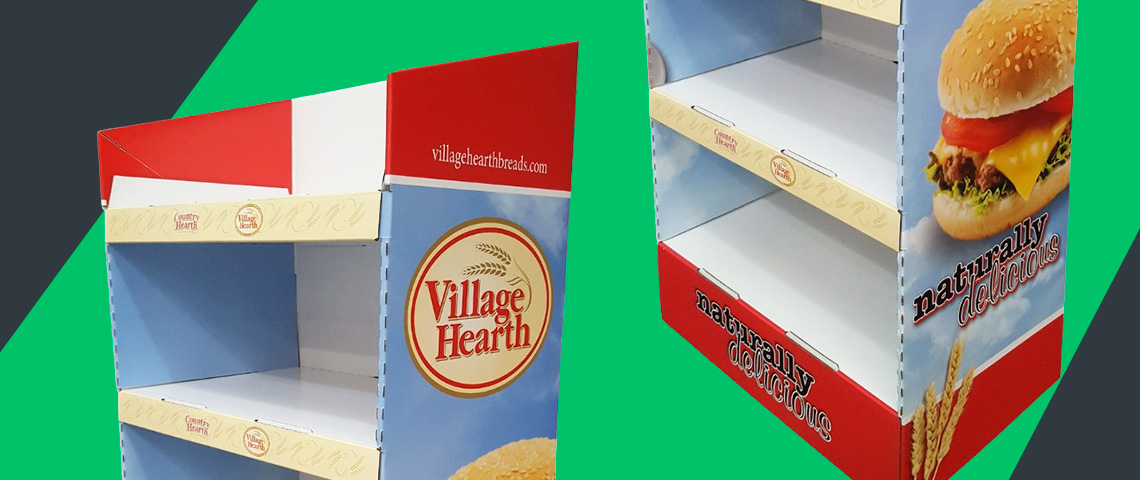
If you’re running an emerging CPG company, the perception that displays are financially out of reach can keep your products invisible on crowded shelves — right when capturing consumer attention matters most. The reality is different. Custom corrugated cardboard displays are more accessible than you might realize, and the return on investment can be transformative.
Consumers make product decisions at the shelf, often discovering new brands in the moment. A well-designed display can be the difference between a product that moves and one that gets lost in the visual noise. For emerging brands with limited budgets, a smart display strategy is essential.
This guide provides a practical playbook for getting high-impact shelf presence without an enterprise-level budget. You’ll discover three core strategies that make custom displays affordable, learn how to control the four key cost drivers that determine your final quote and understand what you can expect at different budget levels.
3 Core Strategies for Affordable CPG Displays
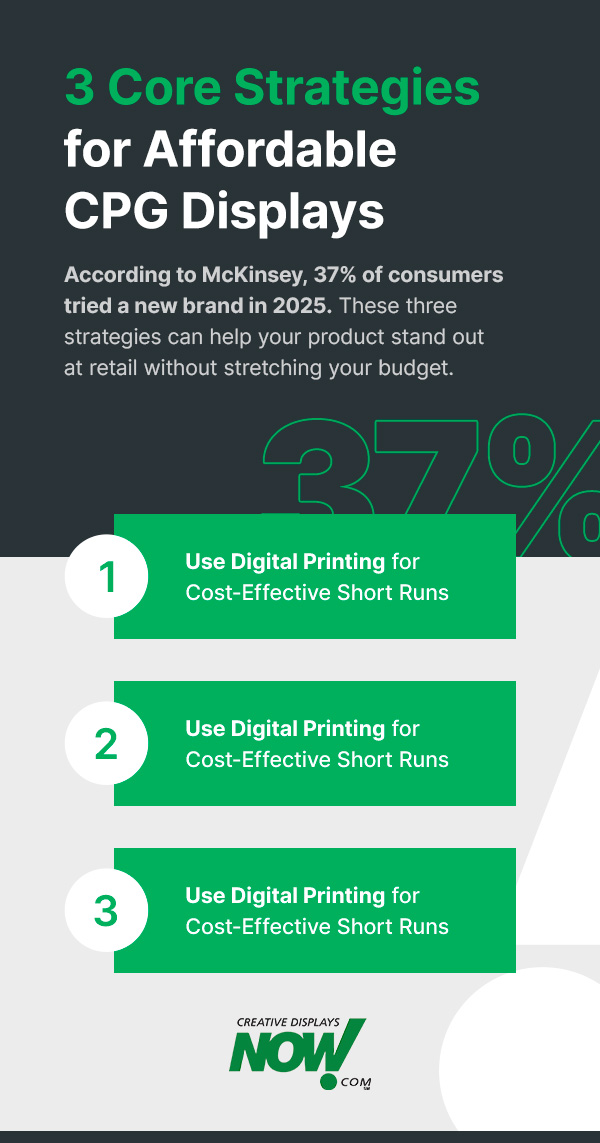
Breaking into retail requires strategic thinking about where to invest your marketing dollars. According to McKinsey, approximately 37% of consumers tried a new brand toward the end of 2025. This willingness to try new brands creates real opportunity, but only if your product stands out at the point of purchase. These three strategies form the foundation of an affordable, results-driven custom display program that won’t strain your resources:
1. Use Digital Printing for Cost-Effective Short Runs
Traditional offset printing requires metal plates that can cost thousands of dollars to produce. For emerging brands ordering 100–500 units, those setup costs make each display prohibitively expensive. Digital printing eliminates this barrier by printing directly onto corrugated material without plates.
The economics shift dramatically at lower quantities. This method becomes the clear financial choice for initial product launches, test marketing campaigns and any project involving multiple product variations. Industry experts confirm that digital printing offers unmatched flexibility for short-run projects, with cost advantages that persist even as order volumes reach the thousands.
Digital printing also provides strategic advantages beyond cost. You can test different display designs across retail locations, gather performance data and refine your strategy before committing to larger production runs. The ability to iterate without financial penalty is particularly valuable when you’re still learning what resonates with your target consumers. Digital printing integrates into standard display development workflows, from design and prototyping through production, without adding the lead time associated with plate creation.
2. Choose Corrugated Material for a High-Impact, Low-Cost Solution
Corrugated cardboard delivers premium visual impact without premium costs. This material accepts high-quality graphics across multiple printing methods, allowing you to create displays that visually compete with products from brands spending 10 times your budget. The lightweight nature of corrugated displays can also significantly reduce shipping costs compared to plastic or metal alternatives.
Sustainability adds another layer of value. Modern consumers increasingly factor environmental considerations into purchasing decisions, with many open to spending more on sustainable packaging. Corrugated displays are fully recyclable and manufactured primarily from post-consumer waste, aligning your brand with consumer values without additional investment.
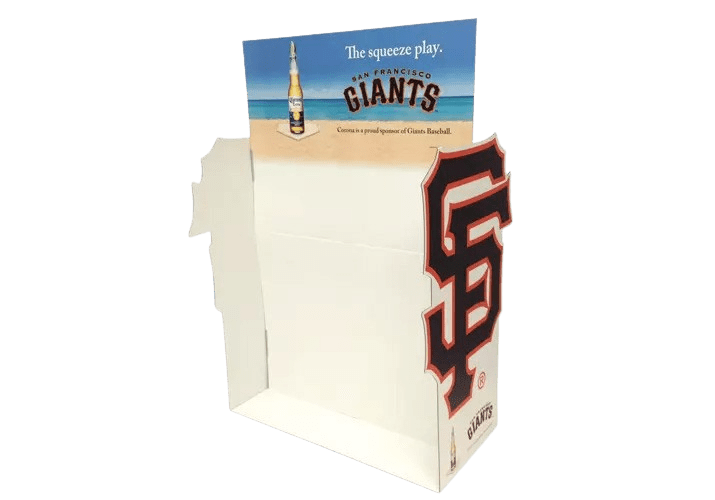
The material works effectively for various display types, from compact counter units to full-scale custom cardboard floor displays that command attention in high-traffic retail areas. Corrugated construction enables creative structural designs that enhance product visibility and encourage shopper interaction, while maintaining the cost efficiency that emerging brands require.
3. Start Smart With Phased Rollouts and Test Programs
Launching wide from day one can be a costly risk and provides no opportunity to course-correct. Instead, start with a targeted test program involving a handful of retail partners. This phased strategy will help you measure the effectiveness of your retail displays with real sales data before you scale.
A successful test run across multiple locations may yield the performance metrics you need to justify broader placement with retail category managers. The data also helps you understand which retail environments produce the best results for your specific product category.
Once you’ve demonstrated consistent performance, securing additional retail distribution becomes significantly easier. You can fuel trials and sustain velocity through strategic display placement that maximizes early momentum while reducing financial exposure.
How to Control the 4 Key Cost Drivers of Custom Displays
Understanding what influences your final quote empowers you to make strategic trade-offs that align with your budget. These four cost drivers account for the majority of your project expenses, and you control all of them through your project specifications.
Minimum Order Quantities (MOQs)
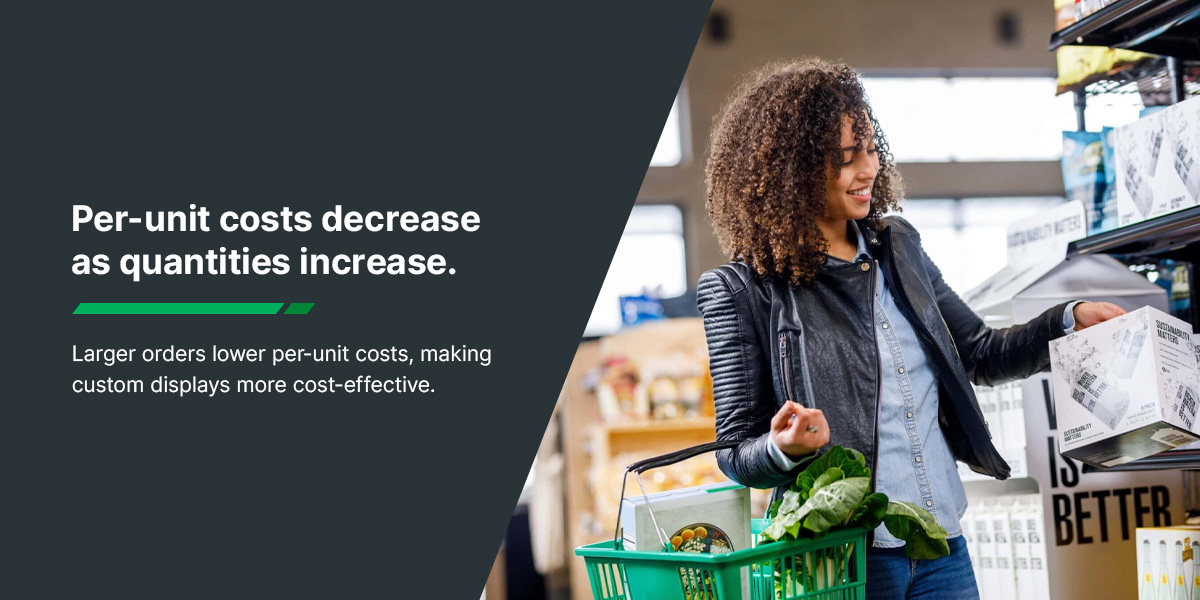
Per-unit costs decrease as quantities increase. This relationship exists across all manufacturing, but it’s particularly pronounced in custom display production. A 500-unit run might cost 40% less per display than a 100-unit run because fixed costs like design, prototyping and production setup are distributed across more units.
However, high minimum order quantities can exclude emerging brands from custom display programs entirely. Many large manufacturers require 500–1,000 units or more. Partners specializing in digital printing and smaller production runs often work with lower minimums, making custom retail display projects accessible to brands in early growth stages.
When planning your first order, balance per-unit economics against practical deployment needs. Ordering slightly more units than your immediate test program requires often makes sense if the per-unit savings justify the additional inventory. Avoid overcommitting to quantities that exceed your realistic placement opportunities over the display’s effective lifespan.
Printing Method
The decision between digital and offset printing directly affects your bottom line. Digital printing eliminates plate costs, making it ideal for short runs. Offset becomes more economical at higher volumes due to lower per-unit ink and production costs. For most emerging CPG companies in the testing and early rollout phases, digital printing typically offers the right balance of quality, flexibility and cost efficiency.
The crossover point generally occurs somewhere between 1,000 and 2,000 units, depending on display size and graphic complexity. Until you reach these volumes consistently, digital printing remains a more cost-effective choice while providing excellent color accuracy and graphic quality.
Material and Structural Complexity
Every custom display requires meticulous structural engineering to ensure it safely holds your products, remains easy to assemble and withstands the rigors of shipping and the dynamic retail environment. When structures are uniquely designed and demand a robust build, the process requires specialized expertise to prevent costly issues.
Design excellence in this area goes beyond just aesthetics. Working with a team of engineering experts ensures every design meets stringent structural requirements and functions reliably. These specialists stay continuously updated on evolving store rules and regulations, which are critical to helping your displays be accepted and perform as intended on the retail floor.
This comprehensive approach to display design means your custom units are stable, compliant and effective at promoting your products, helping you sell more merchandise. By deeply understanding a brand’s products and vision, expert designers craft high-performance displays that authentically represent your unique voice and optimize your investment in shelf presence.
When structures are complex and never-before-manufactured, the design demands significant time for prototyping, iteration and testing — investments that can add thousands of dollars to your project cost.
Display Size and Footprint
Larger units consume more material, require more freight capacity and cost more to produce. Floor space also comes at a premium, and retailers may resist displays that occupy excessive square footage without delivering commensurate sales performance.
Understanding retailer space constraints helps you design within practical parameters. Retailers have specific dimensional requirements for endcaps, counter displays and floor units, with space allocation determined by projected sales velocity and fixture performance.
Starting with more compact, efficient designs helps control costs while proving the concept. Counter displays and slim floor units deliver a strong visual presence without the material and logistics expenses of oversized retail merchandising fixtures. Once you’ve demonstrated sales lift and justified the investment, you can explore larger formats for high-volume retail partners where the space commitment makes sense.
Understanding Investment Levels for Custom Displays
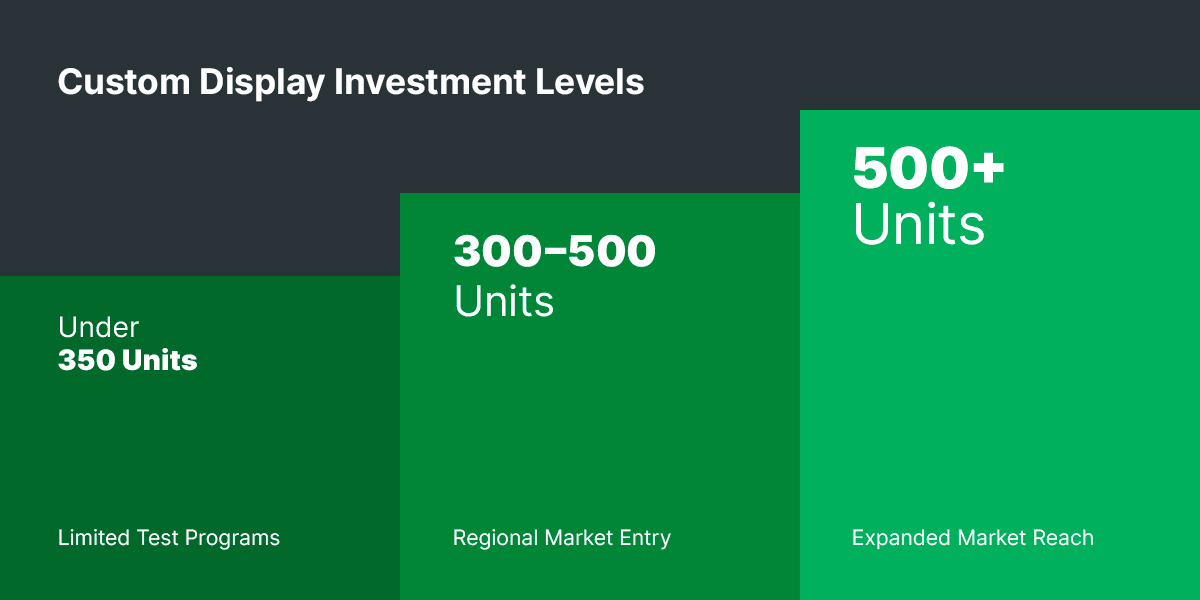
Budget planning for retail displays requires understanding how unit quantities align with manufacturing realities and deployment strategies. Different investment levels support different program goals, from initial market testing to aggressive multi-chain expansion.
Limited Test Programs — Under 350 Units
Creating a display that is unique to your brand involves up-front costs for specialized design, structural prototyping and dedicated production setups. When these essential fixed costs are spread across a very limited number of units, the per-display expense increases.
At this early stage, brands might find it more financially strategic to build their retail presence and sales velocity before committing to a fully custom display program. This focused approach lets you optimize your marketing budget while expanding your distribution footprint. Once your product’s presence grows to a scale that warrants a dedicated and unique presentation, the superior brand differentiation and retail impact of fully custom displays become a clear and valuable investment.
Regional Market Entry — 300–500 Units
The 300–350-unit threshold is when custom display manufacturing typically becomes economically viable. At this volume, tooling costs are spread across enough units to achieve reasonable per-unit pricing while maintaining the brand differentiation and retailer-compliance advantages of fully customized designs.
Retail counter displays work particularly well at this scale, offering high-impact visibility in checkout areas and service counters where impulse purchases drive sales lift. This tier suits brands deploying within a specific retail chain’s footprint or testing market entry before committing to broader expansion. Test comparable store environments within a defined geography, track sales lift against baseline performance and gather retailer feedback. The data you collect can inform expansion decisions without requiring capital commitments that strain emerging brand budgets.
Expanded Market Reach — 500+ Units
Order volumes of 500–2,000+ units can generally support more aggressive market penetration with substantially improved per-unit economics. At this scale, brands typically deploy across multiple retail chains simultaneously or expand from limited distribution to nationwide presence within a single chain.
Corrugated floor displays are often ideal for quantities of 500+ units. Categories where consumers benefit from seeing your full product range work particularly well with this format, as dedicated floor space commands significantly more visual attention than compact alternatives.
Endcap displays represent another strategic option. These prime aisle-end positions direct consumer attention where traffic flow naturally creates viewing opportunities. For established brands expanding distribution or well-funded emerging brands making aggressive market entry, this format delivers visibility that accelerates awareness and trial.
At 2,000+ units, per-unit costs drop further, making large-scale programs increasingly efficient. This scale can support nationwide retail chains, multi-chain strategies across different retail segments or seasonal campaigns that require substantial volume to meet retailer demand across their full footprint.
Comprehensive performance metrics across diverse store environments, geographic markets and retailer types provide the evidence category managers need when considering permanent display programs or expanded distribution authorizations.
How to Maximize Your Display ROI
The goal is a profitable display that delivers measurable returns. Establishing clear metrics before your displays hit retail floors creates the foundation for data-driven decisions about scaling your program. Track these key performance indicators (KPIs) to quantify your display impact:
- Sales velocity comparison: Measure unit sales per store per week with displays versus baseline performance without displays.
- Sales lift percentage: Calculate the percentage increase in sales attributable to display placement.
- Retail environment performance: Compare results across store formats — grocery, mass merchant, specialty retail, club stores — to identify your highest-performing channels.
- Time-based trends: Monitor whether sales lift sustains over the display’s life cycle or diminishes as novelty fades.
Small brands often find they can outshine bigger competitors through strategic display placement that larger brands overlook or consider too granular to pursue. Understanding your specific lift percentage allows you to calculate precise return on display investment and build the business case for scaling the program.
Plan for a measurement window of at least four to six weeks to account for initial placement timing variations and capture representative performance metrics. Work with retail partners to establish SKU-level tracking where possible, as aggregate category results may obscure your specific display contribution. This insight helps you prioritize future placement opportunities and refine your retail strategy.
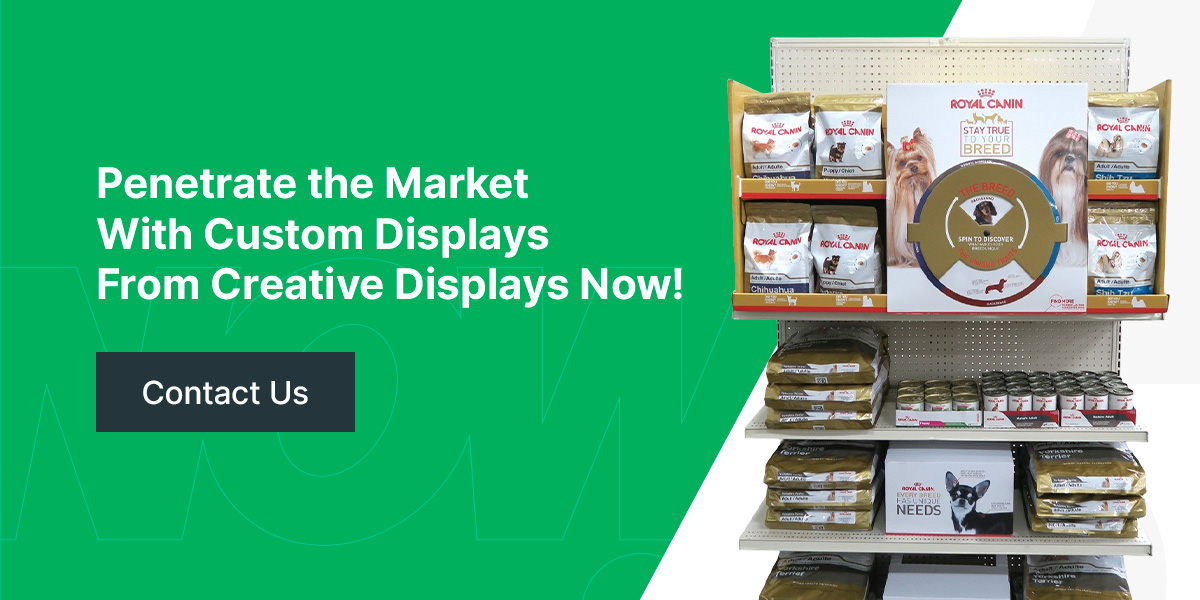
Penetrate the Market With Custom Displays From Creative Displays Now!
Creative Displays Now makes high-impact custom corrugated displays accessible, even for emerging CPG brands navigating their first retail placements. We understand the challenges of constrained budgets and smaller order quantities, and we offer flexible solutions tailored to your unique journey.
With over 60 years of expertise and comprehensive in-house capabilities — including complimentary unprinted structural prototypes to ensure perfect fit and function — we deliver the speed, quality and reliability your brand needs to stand out.
Whether you’re a startup targeting a handful of stores or launching your first retail expansion, let’s discuss your project. Contact us today for a quote tailored to your specific goals and budget!